TPP11: Southeast Asia’s advantage and the giant opportunities for Latin America
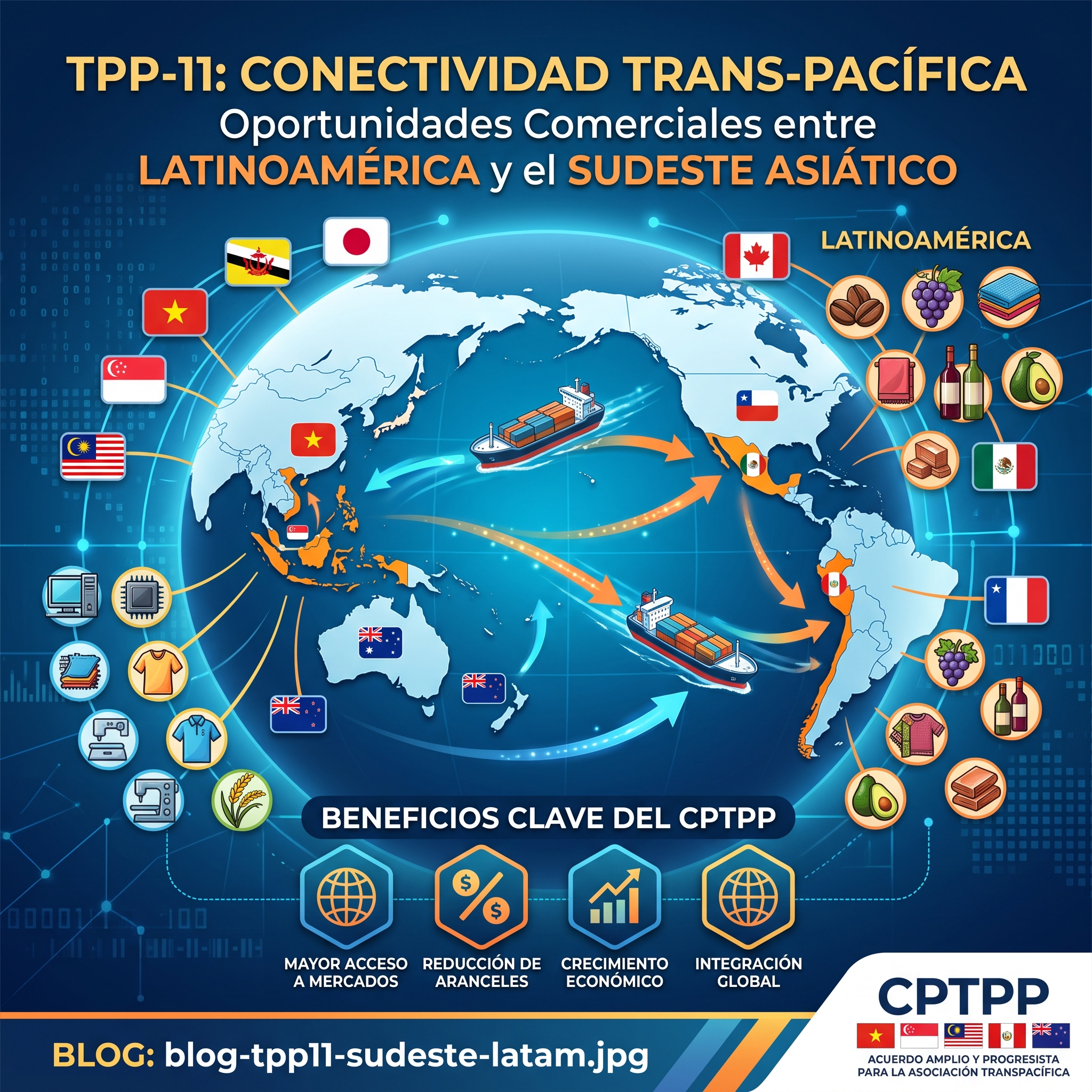
The TPP11 — officially the CPTPP — is today the most demanding and most useful trade club in the Pacific: twelve members, including Vietnam, Malaysia, Singapore and Brunei from Southeast Asia; Mexico, Peru and Chile from Latin America; plus Japan and the United Kingdom, its first European member. And it is growing: in 2026 the bloc negotiates with Uruguay and Costa Rica and opened talks with Indonesia, the Philippines and the UAE.
The advantage Southeast Asia is already using
For Vietnam, Malaysia, Singapore and Brunei, the TPP11 means preferential tariffs and cumulative rules of origin with markets that pay well: Japan, Canada, Australia — and also Mexico, Peru and Chile. Origin cumulation lets members build value chains among themselves: a product made in Vietnam with Japanese inputs keeps bloc origin. The e-commerce, SME and fair-competition chapters add something no bilateral deal offers a mid-size country: regulatory predictability.
The 2026 expansion: more market for everyone
In November 2025 the CPTPP Commission decided to open accession negotiations with Uruguay and to advance with the UAE, the Philippines and Indonesia; in June 2026 preparatory talks began with those three, while Costa Rica moves its process forward. With Indonesia and the Philippines inside, the club would gain some 380 million additional consumers and most of Southeast Asia. Vietnam, which chairs the CPTPP in 2026, is pushing exactly that agenda.
What Latin America can already sell
For Mexico, Peru and Chile the club has been open for years: agro-exports to Japan and Vietnam at preferential tariffs (table grapes, blueberries, avocado, cherries), Chilean salmon with improved access, Mexican beef into Vietnam and Malaysia, wines and pisco gaining recognition across bloc markets. Add digital services, cross-member public procurement, and the chance to triangulate value with Southeast Asia: inputs, packaging and food logistics.
The window for countries still outside
Brazil, Argentina and Colombia are not members — but expansion opens shortcuts: a company operating from Mexico, Peru or Chile can use those platforms to enter Japan and Southeast Asia with TPP11 benefits. And with Uruguay, Ecuador and Costa Rica in the queue, Latin America’s CPTPP map will be wider in 2027. Understanding the agreement before your country joins is a concrete commercial advantage.