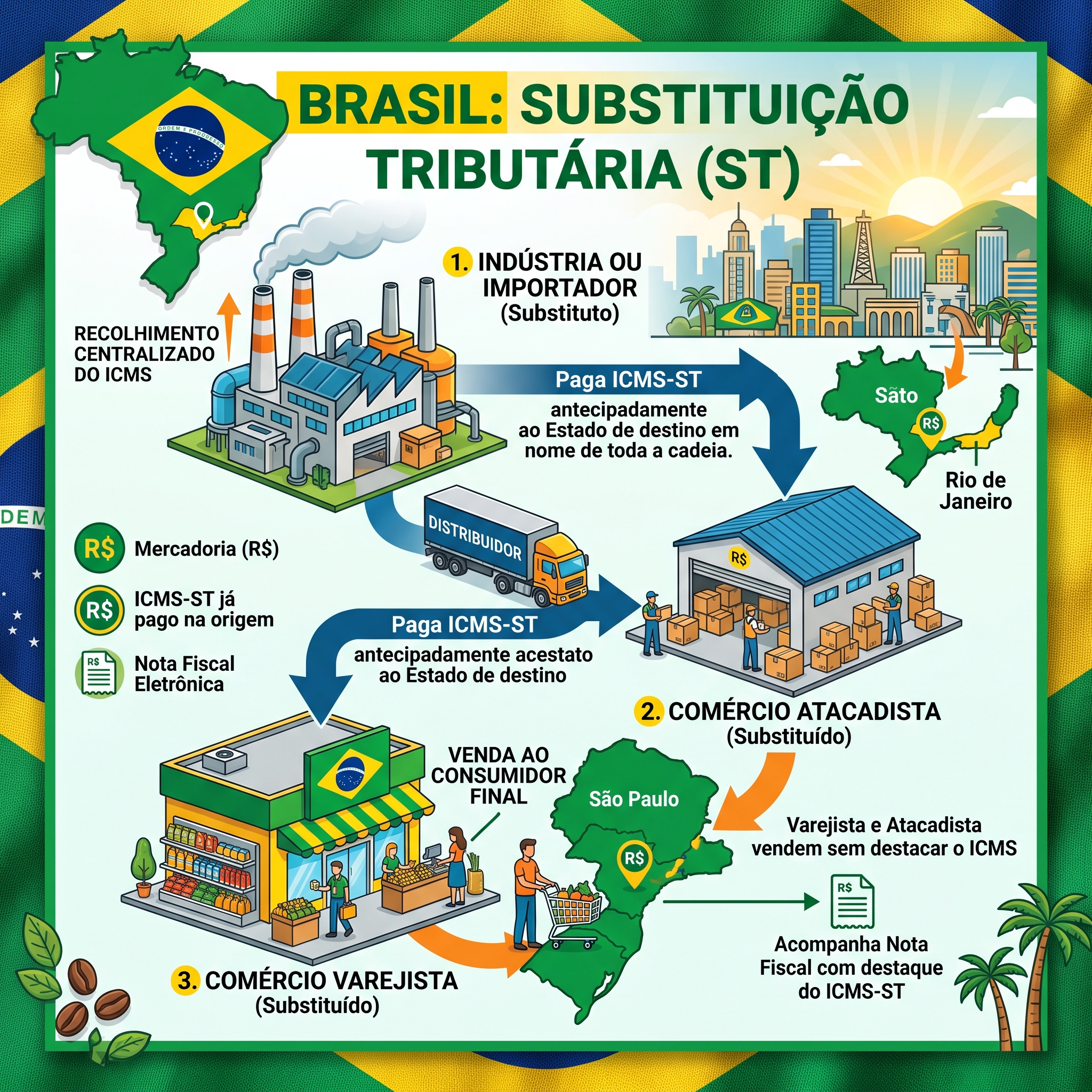
Ask any exporter what scares them about Brazil and the answer is rarely logistics or demand — it is the tax system. Brazil layers federal, state and municipal taxes on top of each other, often with taxes calculated on top of other taxes. Understanding this stack is not an accounting detail: it is the difference between a viable price and a product that never leaves the port.
The five taxes every importer must know
- II (Imposto de Importação). The customs duty, set by the product's NCM classification — typically 0% to 35%, with most manufactured goods between 10% and 20%.
- IPI. A federal excise tax on industrialized products, charged on CIF plus II. Rates range from 0% to over 20% depending on the product's "essentiality."
- PIS/COFINS-Imports. Federal social contributions on imports, generally a combined 9.25% (higher for some categories).
- ICMS. The state-level VAT, usually 17% to 20% or more, calculated "por dentro" — inside its own base — which magnifies its real weight.
- ISS. The municipal services tax (2–5%), relevant when services are part of the operation.
The famous substituição tributária
Within the ICMS lives Brazil's most notorious mechanism: the substituição tributária (ICMS-ST). Instead of every reseller charging ICMS down the chain, the state collects the entire chain's ICMS upfront — from the manufacturer or the importer — calculated on a presumed final consumer price built with a statutory margin (the MVA). Beverages, cosmetics, electronics, auto parts and many food categories are subject to ST.
For importers this has two practical consequences. First, cash flow: you pay the retail-stage tax at the border, long before the sale happens. Second, pricing: if the real consumer price ends up below the presumed MVA, you have overpaid and must claim a refund (ressarcimento) — a slow, state-by-state process. Each of Brazil's 27 states defines its own MVA and product lists, which is why a product can be competitive in São Paulo and unprofitable in another state.
The reform that changes everything (2026–2033)
Constitutional Amendment 132/2023 set Brazil on course to replace five taxes (PIS, COFINS, IPI, ICMS and ISS) with a dual VAT: the federal CBS and the state-municipal IBS, plus a Selective Tax on specific goods. The transition began on January 1, 2026 with test rates of 0.9% CBS and 0.1% IBS coexisting with the full legacy system — old and new tax fields now live side by side on every invoice. From 2027 the CBS reaches its full rate and IPI phases toward zero; from 2029 the ICMS/ISS step down as IBS steps up; by 2033 the old system disappears entirely.
Because the new VAT is destination-based, the reform is designed to eliminate precisely the mechanisms that complicate imports today — DIFAL and the substituição tributária itself. The seven-year transition, however, means importers will manage both regimes in parallel for years.
What to do before you ship
- Classify your product's NCM code correctly — it determines II, IPI and whether ST applies.
- Simulate the full landed cost under today's stack and the emerging CBS/IBS regime.
- Choose your entry state deliberately: ICMS rates, MVA margins and refund speed differ widely.
- Work with a local customs broker and tax adviser; in Brazil, tax strategy is commercial strategy.