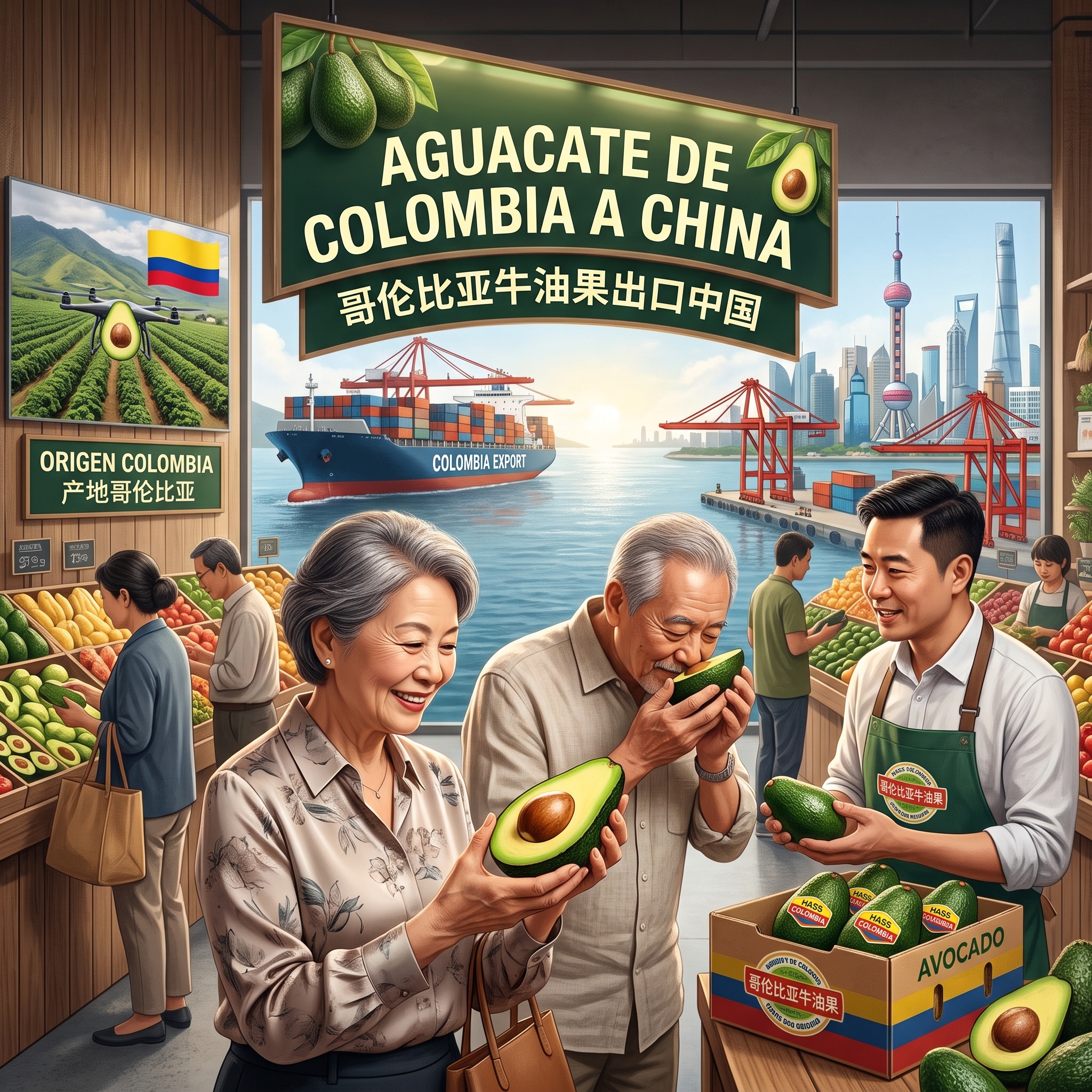
Few agricultural stories in Latin America are as explosive as Colombian Hass avocado. In little more than a decade the country multiplied its planted area and became one of the world's top exporters — with Europe and the United States as its natural outlets. The next frontier is China: a market where per-capita avocado consumption is still a fraction of Western levels, but where every decimal point of growth means tens of thousands of tons.
Access: the protocol is the product
Colombia holds phytosanitary access for fresh Hass avocado to China under the protocol signed between the ICA and Chinese customs (GACC) in late 2019 — making it one of a small club of Latin American origins (alongside Mexico, Peru and Chile) allowed to ship fresh avocados to the mainland. Access comes with conditions that define the whole operation: registered orchards and packing houses, fruit fly monitoring, cold-chain integrity and full traceability from farm to container. New origins keep knocking — Kenya and Rwanda have recently signed protocols, and China granted Kenyan avocados zero tariffs this year — so the window is open but increasingly crowded.
Logistics: a 30-day test of quality
From Buenaventura to Shanghai, containers spend roughly 25 to 30 days at sea. For a climacteric fruit, that is an eternity — and it is why China rewards technical discipline:
- Dry matter at harvest. Fruit cut at 23%+ dry matter arrives with the oil content and flavor that justify a premium.
- Cold chain without breaks. 5–7°C from packing to arrival, with controlled-atmosphere containers on longer routes.
- Arrival conditioning. Chinese retail increasingly sells "ready-to-eat" fruit; ripening programs with local distributors turn a commodity into a category.
The demand side: education and e-commerce
China's avocado consumption grew on the back of health trends, baby food and café culture — avocado toast, smoothies and sushi. Growth is concentrated in tier-1 and tier-2 cities, sold through channels that barely exist elsewhere: fresh e-commerce platforms (Hema, JD Fresh, Pinduoduo), livestream commerce and premium supermarket chains. For exporters this means the buyer is often a platform or an importer-distributor with digital muscle, not a traditional wholesaler. Packaging formats are smaller, barcodes and QR traceability are expected, and marketing is done in-app.
Colombia's real advantages
Colombia's counter-season supply is its trump card: production peaks when other origins slow down, allowing year-round programs when combined with Peru or Mexico. Freight rates from the Atlantic side to Asia have also normalized after the post-pandemic spike. The honest challenges remain consistency (volumes and sizes that match Chinese retail specs), price competition from Peru's massive harvests, and building a country image for Colombian fruit in a market that knows Colombian coffee but not yet its avocado. That brand-building work — trade fairs like China International Import Expo, chef partnerships, in-store activations — is where corridors are actually built.