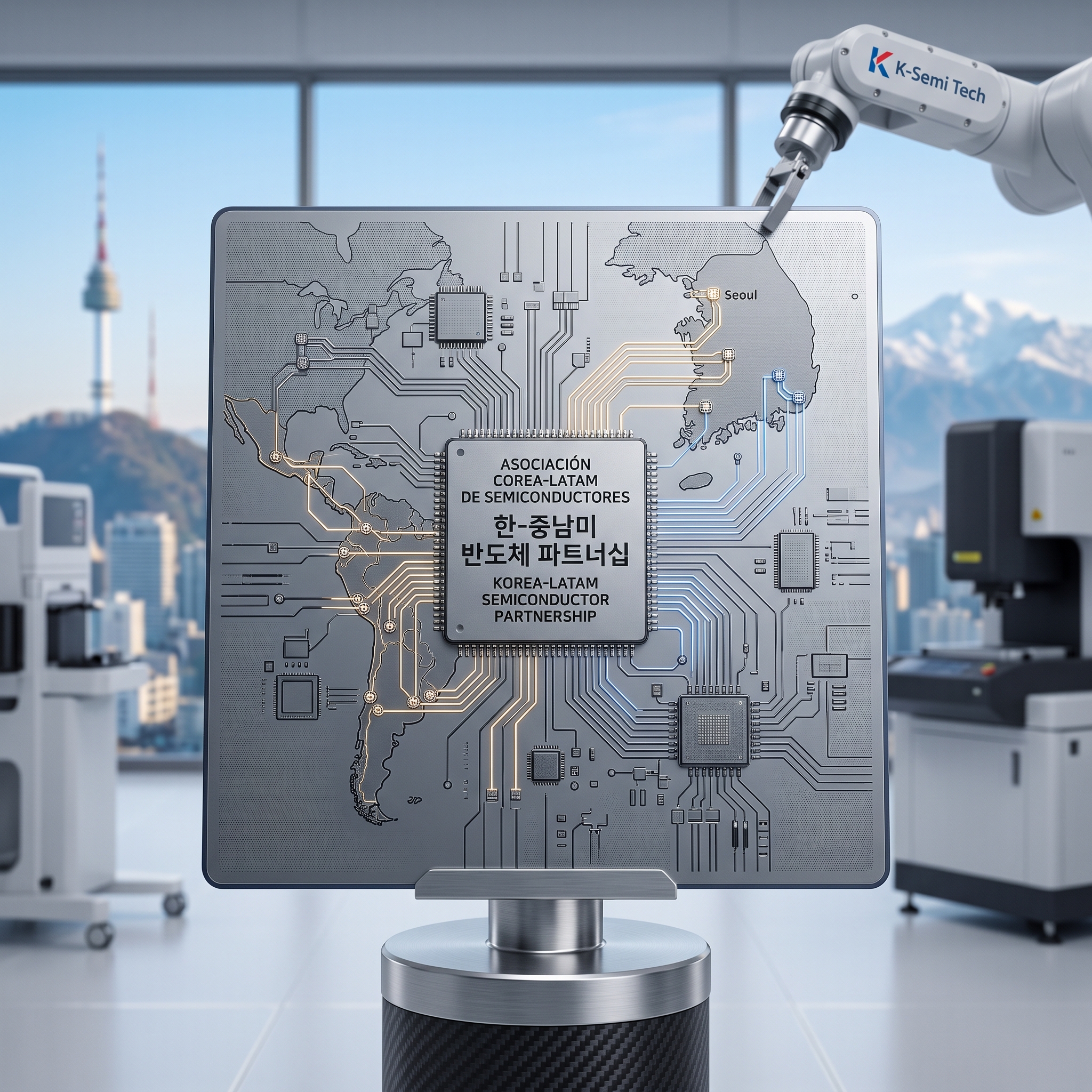
South Korea is living a trade moment without precedent. In May 2026 its exports grew 53% year-on-year to a record US$87.7 billion, powered by a stunning 169% jump in semiconductor shipments. Between January and August, chips alone accounted for roughly 41% of everything Korea sold abroad — some US$281 billion — after 2025 closed with a record US$173 billion in chip exports. The engine is artificial intelligence: data centers devouring high-bandwidth memory as fast as Samsung and SK Hynix can build it.
Anatomy of the supercycle
AI servers need vastly more DRAM and HBM (high-bandwidth memory) than conventional machines, and the industry's capacity is effectively sold out well into the future. Memory contract prices have surged sharply quarter after quarter, and Korean manufacturers are reallocating production from conventional memory toward premium AI chips — which tightens supply (and lifts prices) for the everyday memory used in PCs, phones and cars. Korea, meanwhile, is doubling down: its two champions plus a national strategy aim to cement the country as the world's memory capital for the AI era.
The direct impact on Latin America: your imports get pricier
Latin America is a massive net importer of electronics, and memory is embedded in almost everything — smartphones, laptops, servers, vehicles, point-of-sale terminals. When memory prices spike, device makers pass the cost through, and regional import bills rise. Telecom operators and data-center projects across Brazil, Mexico and Chile are already facing higher capex for memory-heavy equipment. For LATAM distributors and retailers, the practical consequence is simple: expect tighter supply and price increases on memory-intensive products, and plan procurement earlier than usual.
The indirect impact: demand for what LATAM sells
- Copper and critical minerals. The AI build-out is electrification-intensive — data centers, power grids and chips consume enormous amounts of copper, Chile and Peru's flagship export. The semiconductor boom is, upstream, a commodities story.
- Energy. Hyperscalers are hunting for clean, cheap power for data centers; Latin America's hydro, solar and wind resources make the region a candidate for AI infrastructure investment.
- Manufacturing and nearshoring. Korean electronics giants already operate plants in Mexico and Brazil; a structurally larger chip economy strengthens the case for deeper Korean industrial footprints serving the Americas.
What smart companies in the region are doing
Importers are renegotiating contracts with longer validity clauses to hedge memory inflation, and diversifying sourcing between Korean and Taiwanese supply. Exporters of minerals and agri-commodities are positioning for an Asia whose industrial demand is increasingly AI-shaped. And governments are dusting off trade instruments: Chile's FTA with Korea — the first between an Asian and a Latin American country — and Korea's ongoing engagement with the Pacific Alliance show the institutional corridor already exists. The supercycle will normalize someday; the trade relationships built during it will not.